“The cardinals assembled at Perugia after the death of Pope Nicholas IV in April 1292. After more than two years, a consensus had still not been reached. Pietro, well known to the cardinals as a Benedictine hermit, sent the cardinals a letter warning them that divine vengeance would fall upon them if they did not quickly elect a pope. Latino Malabranca, the aged and ill dean of the College of Cardinals cried out, “In the name of the Father, the Son, and the Holy Ghost, I elect brother Pietro di Morrone.” The cardinals promptly ratified Malabranca’s desperate decision. When sent for, Pietro obstinately refused to accept the papacy, and even, as Petrarch says, tried to flee, until he was finally persuaded by a deputation of cardinals accompanied by the king of Naples and the pretender to the throne of Hungary.”
I learned something new and horrifying today which is… that… no submarine is ever considered “lost” … there is apparently a tradition in the U.S. Navy that no submarine is ever lost. Those that go to sea and do not return are considered to be “still on patrol.”
?????
There is a monument about this along a canal near here its… the worst thing I have ever seen. it says “STILL ON PATROL” in huge letters and then goes on to specify exactly how many WWII submarine ghosts are STILL OUT THERE, ON PATROL (it is almost 2000 WWII submarine ghosts, ftr). Here is the text from it:
“U.S. Navy Submarines paid heavily for their success in WWII. A total of 374 officers and 3131 men are still on board these 52 U.S. submarines still on patrol.”
THANKS A LOT, U.S. NAVY, FOR HAVING THIS TOTALLY NORMAL AND NOT AT ALL HORRIFYING TRADITION, AND TELLING ALL OF US ABOUT IT. THANKS. THANK YOU
anyway now my mother and I cannot stop saying STILL ON PATROL to each other in ominous tones of voice
There’s definitely something ominous about that—the implication that, one day, they will return from patrol.
Actually, it’s rather sweet. I don’t know if this is common across the board, but my dad’s friend is a radio op for subs launched off the east coast, and he always is excited for Christmas, because they go through the list of SoP subs and hail them, wishing them a merry Christmas and telling them they’re remembered.
Imagine a country whose seamen never die, and whose submarines can’t be destroyed…because no ones sure if they exist or not.
No but imagine. It’s Christmas. A black, rotting corridor in a forgotten submarine. The sound of dripping water echoes coldly through the hull. You can’t see very far down the corridor but then, a man appears, he’s running, in a panic, but his footsteps make no noise. The spectral seaman dashes around the corner and slips through a rusty wall. He finds himself at the back of a crowd of his cadaverous crew-mates. They part to let him through. He feels the weight of their hollow gaze as he reaches the coms station. Even after all these years a sickly green light glistens in the dark. The captain’s skeleton lays a sharp hand on his shoulder and nods at him encouragingly, the light sliding over the bones of his skull. The ghost of the seaman steadies himself and slips his fingers into the dials of the radio, possessing it. It wails and screeches. A bombardment of static. And then silence. The deathly crew mates look at each other with worry, with sadness; could this be the year where there is no voice in the dark? No memory of home? The phantasm of the sailor pushes his hand deeper into the workings of the radio, the signal clears, and then a strong voice, distant with the static but warm and kind, echoes from the darkness; “Merry Christmas boys, we’re all thinking of you here at home, have a good one.” A sepulchral tear wafts it’s way down the seaman’s face. The bony captain embraces him. The crew grin through rotten jaws, laughing silently in their joy. They haven’t forgotten us. They haven’t forgotten.
I am completely on board with this. It’s not horrifying, it’s heartwarming.
Personal story time: whenever I go to Field Museum’s Egypt exhibit, I stop by the plaque at the entrance to the underground rooms. It has an English translation of a prayer to feed the dead, and a list of all the names they know of the mummies on display there. I always recite the prayer and read aloud the list of names. They wanted to live forever, to always have their souls fed and their names spoken. How would they feel about being behind glass, among strangers? Every little thing you can do to give respect for the dead is warranted.
I love the idea of lost subs still being on patrol. Though if you really want something ominous, let me say that the superstitious part of me wonders: why are they still on patrol? If they haven’t been found, do they not consider their mission completed? What is it out there that they are protecting us from?
There’s been something in the water since we first learned to float on it. Not marine life, although there’s more of that than we’ll ever know. Not rocks and currents and sand bars and icebergs either, although they’ve all taken more than their share of human life.
But something deeper. Something Other. Something not natural.
Sailors have always been superstitious.
Not one of them described it right.
You don’t hear about it so much now that we don’t lose ships anymore, really, not like we did at the height of the sea trade when barely an inch of ocean floor didn’t bear some wreck or other. And better ships and GPS and weather satellites have all played their part in that.
But we have protection now that we didn’t before. They don’t interfere with war and battle, even on behalf of what used to be their country, or with rocks and weather and human stupidity. Those are concerns for the living.
But the Other Things, the Things that shouldn’t be there – They can’t get to us now without a fight. It’s a fight They haven’t won in a very long time.
As long as we remember them, as long as we call out to them – not very often, just once a year will do – they will keep protecting us from the Things that go bump in the deep.
More than fifty submarines, Still On Patrol.
I love everything about this, but it’s the last bit that made me say “okay now I’ll reblog it.”
Okay, it’s official. I’ve found my favourite historical anecdote of all time.
So in ancient Rome they had this tradition where they had to consult the gods and check they had divine approval before they went into battle. They did this by bringing forth a flock of sacred chickens and throwing grain at them. Their behaviour would then determine whether or not the gods were on your side. If the hens didn’t eat or wouldn’t leave their cage, it was a Bad Omen and you had to postpone battle and ask again the next day. If the chickens ate happily it was a Good Omen and you could go and chop up some Gauls or Carthaginians or whoever you happened to be fighting.
Now, there are lots of little stories about these chickens, but I just found one I hadn’t seen before. In 137 BC, the consul C. Hostilius Mancinus tried to take auspices before battle, but:
the chickens once released from their cage fled into a nearby wood and even though they were sought with the greatest diligence, they could not be recovered.
Can you fucking believe that. Can you actually believe that happened. The Romans have a reputation for being so stern and sensible and stoic and that happened. Like… everyone’s ready for battle, so you turn to your assistant and say “BRING FORTH THE CHICKENS” and you throw down the grain and open up their cage and the chickens just. run. they fucking run. those tiny velociraptor bastards abscond screaming into the woods like there’s no tomorrow. Blinking in disbelief, you send soldiers into the woods to recover them but those feathered bandits are gone. Vanished. The gods have deserted you. You’re beating bushes and following the sounds of triumphant clucks. The soldiers are frantic. The chickens are gone.
He lost the battle. It was a Bad Omen.
That sounds like the ultimate Bad Omen like at that point you go home and start drawing up an armistice bc the gods told you to go fuck yourself with chickens
That’s… pretty much what happened. The chicken omen, along with a few other Bad Omens, resulted in:
infelici pugna, turpi foedere, deditione funesta
“a lost battle, a shameful peace treaty, and a calamitous handover.”
so yeah, he lost the battle and had to go home and sign an embarrassing peace treaty that the Romans complained about years later, and when they talk about him they curse him for his praecipitem audaciam – “reckless audacity” – and vesana perseverantia “insane obstinacy” because NONE OF THIS WOULD HAVE HAPPENED IF YOU’D LISTENED TO THE CHICKENS AND POSTPONED BATTLE LIKE THEY TOLD YOU.
Don’t forget naval commander Claudius Pulcher, whose sacred chickens refused to eat anything before the battle of Drepana. He tossed the chickens overboard, saying if they won’t eat, then let them drink, and went into battle where he promptly lost almost all of his ships and crew. I forget if he died or returned to Rome in disgrace, but it was a freaking disaster and the sacred chickens called it.
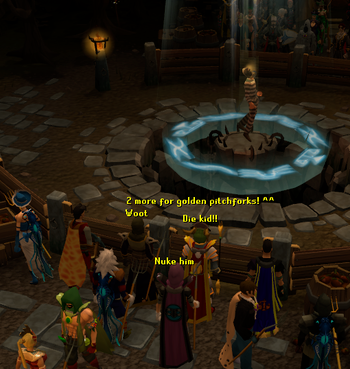
on the subject of bots, runescape had literally the best way of dealing with their botting problem:
if an account was detected using bot software, they would be instantly teleported to a hearing from a witchfinder general style npc, where other players could watch and throw rotten tomatoes at them. then the audience could vote on how the person on trial would be killed as punishment, and THEN the botter was permanently banned afterwards. it was the funniest shit ever
The best parts I like about old treaties is when the masters teach you some real, everyday life survival skills / advice, sometimes oddly specific. I’m talking about the REAL stuff, not the usual “if he do this then counter it by stabbing them in the face“
Examples: “When you have a rapier some people use in the other hand a cape, or a parry dagger, but just take a pistol and decide for yourself what’s the best off-hand weapon”
“If there is a large group coming for you, throw your sword at them this way, then run in the other direction REALLY fucking fast. _Buy a new sword as soon as possible_”
“If you have a disagreement with someone and he is stronger than you hold up your sword like a cross and ‘vow to this cross’ that you will make peace with him. When he isn’t paying attention bash his face with the pommel.“
“If someone tries to do the ‘cross trick’ to you put your hand on it saying ‘I vow to it too’ so he can’t bash your face with it“
“Some people put acidic/poisonous stuff in a hole in their mace so when they swing at you it will also go into your eyes. You TOTALLY won’t do this dishonorable thing, but here is the recipe for that stuff for the sake of knowledge“
“If in a duel you have to change swords with your opponent to make sure there is no cheating, and his sword is more expensive than yours, just run the fuck away with it.“
Aristander of Telmessos is one of my favorite figures from classical history. He was Alexander the Great’s personal soothsayer, and he was never wrong. The Greeks themselves assumed he had mystical knowledge that let him pierce the veil of time. My skeptical interpretation is that he was a shameless flatterer who got lucky.
Imagine. You’re hired by this new boy-king you’ve never heard of. He says “I’m going try to conquer Thebes, predict what will happen”. You don’t know much about Thebes, but you know where your bread gets buttered. “Oh, it will be a great triumph, Your Majesty, remembered in song for centuries to come.”
Then he comes back “Wow, you were totally right about that one, they’re already writing the songs. Maybe I should just conquer all of Greece now, what do you think about that?” “Uh, it will be a resounding victory, my lord, everything will go exactly as you planned”.
Then Alexander comes back. “Very impressive, right again! Maybe I should just take on the whole Persian Empire single-handed, what do you think?” At this point Aristander must be wondering if his luck has run out. But Alexander seems like the wrong guy to cross, and you don’t want to seem disloyal, so you just say “Well, yes, sure, that will work out just fine.” And it does.
So then Alexander shakes your hand and says “You know, you’re the only guy I can really trust about this stuff. So, well, I’ve got Greece. I’ve got Persia. I don’t really know what else there is in the world, but I think I might just try marching east and conquering everything I see. What are your thoughts?” And by now you know the score, so you just say “Yes, Your Majesty, whatever you say, it’s a great idea and I’m sure you’ll win a legendary victory over whatever the heck there is east of the known world.” A few years later, a messenger from some ethnicity you’ve never seen, wearing strange clothing made from an animal you thought was mythical, brings you a letter that just says “RIGHT AGAIN – LOVE, ALEX”.
And so you go down in legend as one of history’s most accurate soothsayers.
My favorite Aristander story is when Alexander is besieging the city of Tyre. He’s getting tired (no pun intended) of the siege, so he asks Aristander when he’ll finally win the victory. “This month,” says Aristander confidently, forgetting that it is the last day of the month and the city is widely considered impregnable. Alexander is sort of concerned, and doesn’t want to break his lucky streak of all the prophecies coming true, so he makes an emergency decree changing the calendar and adding two days on to the end of the month to give him more time. Then he feels bad about it, attacks the city, and captures it that day.
“How do you do it?” he asks a face-palming Aristander. “You’re always right. It’s just spooky.”






 This Is a Backup Blog