No media about the fact that there’s a All Male, African American High school on the southside of chicago who year after year has a 100% graduating senior class who ALL get accepted to 4 year universities/colleges.
they just want to talk about how whether a person’s death on the southside is gang related or not.
WHAT
This is ridiculously impressive.
I’m just looking up sources, and the statistics are really incredible.
Tag: ooh

College mail received by a high schooler in Montana, by state
This is art

Susanna and the Elders, Restored (Left)
Susanna and the Elders, Restored with X-ray (Right)
Kathleen Gilje, 1998
wow
Oooh my gosh this is rad. This is so rad.
For those who don’t know about this painting, the artist was the Baroque artist Artemisia Gentileschi.
Gentileschi was a female painter in a time when it was very largely unheard of for a woman to be an artist. She managed to get the opportunity for training and eventual employment because her father, Orazio, was already a well established master painter who was very adamant that she get artistic training. He apparently saw a high degree of skill in some artwork she did as a hobby in childhood. He was very supportive of her and encouraged her to resist the “traditional attitude and psychological submission to brainwashing and the jealousy of her obvious talents.”
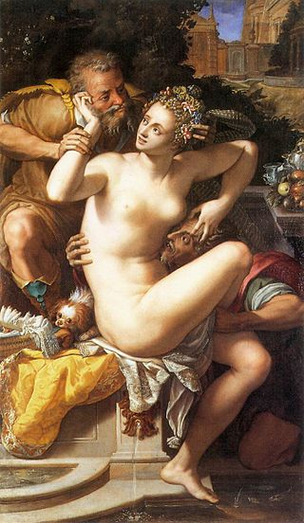
Gentileschi became extremely well known in her time for painting female figures from the Bible and their suffering. For example, the one seen above depicts the story from the Book of Daniel. Susanna is bathing in her garden when two elders began to spy on her in the nude. As she finishes they stop her and tell her that they will tell everyone that they saw her have an affair with a young man (she’s married so this is an offense punishable by death) unless she has sex with them. She refuses, they tell their tale, and she is going to be put to death when the protagonist of the book (Daniel) stops them.
So that painting above? That was her first major painting. She was SEVENTEEN-YEARS-OLD. For context, here is a painting of the same story by Alessandro Allori made just four years earlier in 1606:
Wowwwww. That does not look like a woman being threatened with a choice between death or rape. So imagine 17 year old Artemisia trying to approach painting the scene of a woman being assaulted. And she paints what is seen in the x-ray above. A woman in horrifying, grotesque anguish with what appears to be a knife poised in her clenched hand. Damn that shit is real. Who wants to guess that she was advised by, perhaps her father or others, to tone it down. Women can’t look that grotesque. Sexual assault can’t be depicted as that horrifying. And women definitely can’t be seen as having the potential to fight back. Certainly not in artwork. Women need to be soft. They need to wilt from their captors but still look pretty and be a damsel in distress. So she changed it.
What’s interesting to note is that she eventually painted and stuck with some of her own, less traditional depictions of women. However, that is more interesting with some context.
(Warning for reference to rape, torture, and images of paintings which show violence and blood.)
So, Gentileschi’s story continues in the very next year, 1611, when her father hires Agostino Tassi, an artist, to privately tutor her. It was in this time when Tassi raped her. He then proceeded to promise that he would marry her. He pointed out that if it got out that she had lost her virginity to a man she wasn’t going to marry then it would ruin her. Using this, he emotionally manipulated her into continuing a sexual relationship with him. However, he then proceeded to marry someone else. Horrified at this turn of events she went to her father. Orazio was having none of this shit and took Tassi to court. At that time, rape wasn’t technically an offense to warrant a trial, but the fact that he had taken her virginity (and therefore technically “damaged Orazio’s property”. ugh.) meant that the trial went along. It lasted for 7 months. During this time, to prove the truth of her words, Artemisia was given invasive gynecological examinations and was even questioned while being subjected to torture via thumb screws. It was also discovered during the trial that Tassi was planning to kill his current wife, have an affair with her sister, and steal a number of Orazio’s paintings. Tassi was found guilty and was given a prison sentence of…. ONE. YEAR……. Which he never even served because the verdict was annulled.
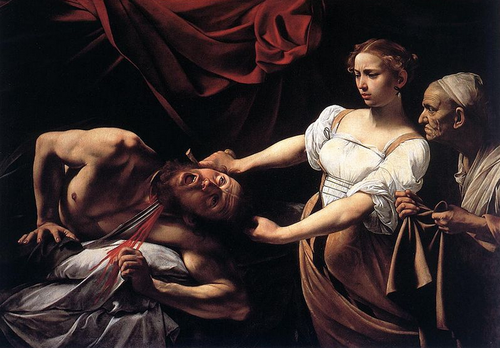
During this time and a bit after (1611-1612), Artemisia painted her most famous work of Judith Slaying Holofernes. This bible story involved Holofernes, an Assyrian general, leading troops to invade and destroy Bethulia, the home of Judith. Judith decides to deal with this issue by coming to him, flirting with him to get his guard down, and then plying him with food and lots of wine. When he passed out, Judith and her handmaiden took his sword and cut his head off. Issue averted. The subject was a very popular one for art at the time. Here is a version of the scene painted in 1598-99 by Carivaggio, whom was a great stylistic influence on Artemisia:
This depiction is a pretty good example of how this scene was typically depicted. Artists usually went out of their way to show Judith committing the act (or having committed it) while trying to detach her from the actual violence of it. In this way, they could avoid her losing the morality of her character and also avoid showing a woman committing such aggression. So here we see a young, rather delicate looking Judith in a pure white dress. She is daintily holding down this massive man and looks rather disgusted and upset at having to do this. Now, here is Artemisia’s:
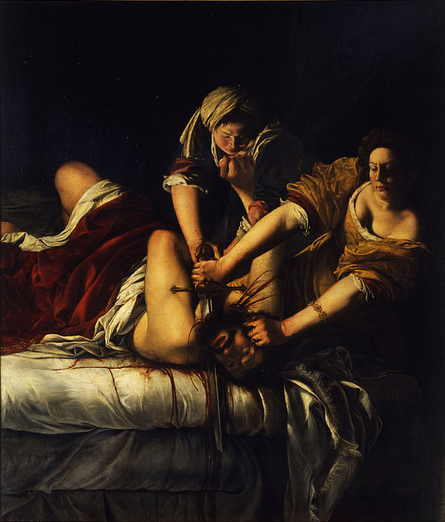
Damn. Thats a whole different scene. Here Holofernes looks less like he’s simply surprised by the goings ons and more like a man choking on his own blood and struggling fruitlessly against his captors. The blood here is less of a bright red than in Carrivaggio’s but is somehow more sickening. It feels more real, and gushes in a much less stylized way than Carrivaggio’s. Not to mention, Judith here is far from removed from the violence. She is putting her physical weight into this act. Her hands (much stronger looking than most depictions of women’s hands in early artwork) are working hard. Her face, as well, is completely different. She doesn’t look upset, necessarily, but more determined.
It’s also worth note that the handmaiden is now involved in the action. It’s worth note because, during her rape trial, Artemisia stated that she had cried for help during the initial rape. Specifically she had called for Tassi’s female tenant in the building, Tuzia. Tuzia not only ignored her cries for help, but she also denied the whole happening. Tuzia had been a friend of Artemisia’s and in fact was one of her only female friends. Artemisia felt extremely betrayed, but rather than turning her against her own gender, this event instilled in her the deep importance of female relationships and solidarity among women. This can be seen in some of her artwork, and I believe in the one above, as well, with the inclusion of the handmaiden in the act.
So, I just added a million words worth of information dump on a post when no one asked me, but there we go. I could talk for ages about Artemisia as a person and her depictions of women (even beyond what I wrote above. Don’t get me started on her depictions of female nudes in comparison to how male artists painted nude women at the time.)
To sum up: Artemisia Gentileschi is rad as hell. This x-ray is also rad as hell and makes her even radder.
I love art history.
I’m reblogging this again to add something that I also think is important to know about Artemisia Gentileschi.
Back in her time and through even to TODAY, there are people who argue that her artworks were greatly aided by her father…. As in he either helped her paint them or just straight up painted them himself. Hell, there are a number of works only recently (past several years or so) that have been officially attributed to Artemisia because people originally saw the signature with “Gentileschi” in it and automatically attributed it to Orazio.
So, not only was Artemisia Gentileschi an amazing artist and amazing historical figure, but I don’t want it to be ignored that there are people over 400 years later who still won’t give her the credit she deserves, just because she’s a woman and obviously women can’t paint like she did.I fucking love Artemisia Gentileschi

Hey Tumblr, you know how you keep saying you would love a sports anime with girls??? BOOM.
This is Princess Nine, a 1998 anime about a group of high school girls who form a baseball team and basically destroy all the boys in the national high school baseball league.
It’s super nineties so you got your goofy animation with super varied characters, deep sorrowful violin music, backgrounds on fire during climaxes, the whole shebang. Also it deals with a lot of things like misogyny in sports & business, growing up, strong male-female friendships, LOTS of different female friendships and teamwork, and is just generally a wonderful anime.
Have I mentioned there’s a great variety of characters? Both personality-wise and physically! You have your resident uppity protagonist with a tragic backstory to unlock, the girl frenemy everyone wants to ship her with, and so many?? Like wow. Not to mention the main male characters who act as the main girl’s love interests are both very sweet and get along with each other?? Also you want like half the girls to step on you. Like “Be my queen and use me as a footrest” feelings about these girls.
But yeah! Please go go go watch this anime it’s amazing and just as good if not better than all the recent sport animes that have come out! Also kudos to Katt for having a flashback to her childhood about this anime I don’t know what we would be watching if she didn’t.
i’ve cried like three times over this anime pls watch it okay


This Dyslexic-Friendly Font Could Help The 1 In 5 People Living With Condition
A few subtle tweaks to a letter’s shape can make a world of difference to some readers.
By creating a new typeface with slight but impactful changes, Dutch designer Christian Boer is making reading an easier task for those, like himself, who live with dyslexia. Letters of the Dyslexie font have heavy base lines, alternating stick and tail lengths and semicursive slants — all modifications that differentiate letters that can look confusingly similar to those with the condition.
We Don’t Need Another Straight, White, Able-bodied Hero
When Rachel Manija Brown and Sherwood Smith initially sent their postapocalyptic YA western, Stranger, out on submission, agents asked them to de-gay the book. They refused but persevered, and Stranger has just been published by Viking Juvenile. This is the story of that book’s inspiration.
By Rachel Manija Brown and Sherwood Smith
Rachel Manija Brown: A number of years ago, I was working at the Jim Henson Company (The Muppets; Labyrinth), optioning books to be made into movies and TV shows. But what I really wanted was to create my own stories.
I’ve always loved the images and story elements of Westerns — the stranger who comes to town and shakes things up, the desperate chase through the desert, the man with no name, the tough sheriff, the saloon where everyone in town comes to gossip. But I wanted one where the characters were more like me, and more like the people who live in the west now.
The real California of the Gold Rush was much more diverse than it’s usually portrayed: Jews were there, and free black people, and Chinese people; Indians from various tribes, and people from Mexico, Chile, and Peru. Not to mention a whole lot of incredibly tough women. It was by no means a multicultural paradise. But it also wasn’t a place where everyone was white and women existed only as saloon girls, loyal wives, and prizes to be won by the male hero.
Then I imagined a future west: a post-apocalyptic Los Angeles where technology had reverted back to Gold Rush levels, but which was still as diverse as the real city I lived in. An image came to my mind, of a teenage boy desperately fleeing through the desert, without food or water but carrying something precious in his battered pack. A bounty hunter was relentlessly tracking him, and the desert was full of mutated bloodsucking plants. Could he reach the refuge of a small frontier town before he succumbed to thirst, or deadly wildlife, or a bullet?
I could see that boy in my mind’s eye. He didn’t look like the typical tall, light-skinned, blue-eyed hero of a western. He looked like the young men I saw every day in Los Angeles, the young men who had really lived in the California of the Old West. His skin was brown and his hair was black; he wasn’t tall or burly, but he was stronger than he looked. I wondered what it was that he had in his pack, that he was so desperate to protect…
Years later, I met Sherwood to collaborate on a TV show, and I told her about that idea. By then the young man had a name: Ross Juarez.
Sherwood Smith: I loved it! We talked back and forth, scribbling down our favorite ideas: mysterious ruins and super powers, and taking familiar tropes and turning them inside out. The brainy mechanic sidekick, who’s always a guy, would be a girl who has trouble getting outside of her own head. And she wouldn’t be a sidekick, but the heroine. The tough sheriff would be a woman — a super-strong woman, with half her face beautiful and half a skull! The town was guarded not only by adult men, but by all the townspeople — including teenagers. Some with powers, some not! And if a love triangle developed, we’d take it in a completely new direction.
In listing all our favorite tropes (super-powers! Bad-ass teens! Weird flora and fauna! Interesting food from many cultures!), we discovered that we were also on the same wavelength concerning diversity.
Rachel: I’d volunteered with the Virginia Avenue Project for years. It’s a program to mentor low-income kids and teenagers through the arts. I used to take the kids to a bookstore and let them buy anything they wanted to read. One day an African American girl mentioned that every time she picked up a book with a cover that showed a girl like her, she’d find that it was about gangs, drugs, or teen pregnancy.
“I don’t relate to that!” she said. She wanted to read about black girls who were like her: who read books, who had many interests and a loving family, and who had absolutely nothing to do with gangs or drugs. And she wanted them to have the sorts of adventures that you can only have between the pages of a book.
Sherwood: When I was in high school, I had a friend of color who admitted that much as she loved fairy tales, she wished that just once the heroine wouldn’t be pale, with golden hair, and eyes like sapphires. What would be so wrong about a heroine with brown skin, eyes, and hair?
Because both of us have people in our lives — friends, brothers, sisters, aunts, great-uncles, and so forth — who happen to be gay or disabled, we wanted not only to reflect the patterns of ordinary life in our story, but to write one in which people who seldom get to see characters like themselves as heroes get to do just that. And, of course, in many ways we ourselves don’t fit into the standard heroic mold.
It seemed natural to map our future Los Angeles over the actual demographics of LA. White people are already a minority; 50% of the city is Hispanic/Latino. Today many people face prejudice based on their race, gender, sexual orientation, or religion. After an apocalypse, we thought that many old prejudices would die out, once the power structure that sustained them was gone. But humans being humans, new ones have replaced them, specifically a bias against the mutated “Changed” folk.
We began the story as a screenplay, but the worldbuilding and the story became so involved that we turned it into a book. Because we wanted the story to be about a community, we wrote it as an ensemble piece. The points of view rotate between five main characters. Selling this book, however, was difficult —
and for unexpected reasons: “Authors Say Agents Try to ‘Straighten’ Gay Characters in YA” (Genreville at Publishers Weekly)
There are two important takeaways. First, it wasn’t just one agent who wanted us to make one of our protagonists straight. That agent was just more upfront about it — and made it very clear that it wasn’t because they were personally anti-gay, but because they believed that no one would buy a book with a gay hero.
The second important takeaway is that when we discussed this in private with some other writers, we got an outpouring of letters from other writers who’d had similar experiences, with agents or editors or simply family members who earnestly warned them that received wisdom stated you can’t sell a book with a gay hero, or a Hispanic hero, or a disabled hero.
Our article prompted fantasy writer Malinda Lo to analyze all YA novels published in the US. She found that fewer than 1% of all YA novels have any LGBTQ characters at all, even minor supporting characters. A slightly larger number have heroes (as opposed to sidekicks and supporting characters) who are anything other than white, straight, and able-bodied.
We are not the only writers would like to see more types of heroes, in more types of stories. If you’re interested in reading more YA fantasy and science fiction with diverse heroes of various sorts, try books by Malorie Blackman, Joseph Bruchac, Sarwat Chadda, Sarah Diemer, Alaya Dawn Johnson, Cynthia Leitich Smith, David Levithan, Malinda Lo, Marie Lu, Patrick Ness, Ellen Oh, Nnedi Okorafor, Tamora Pierce, Cindy Pon, Rick Riordan, Sherri Smith, or Laurence Yep. And they’re not the only ones writing diverse characters. There are more extensive book lists here.
Our belief is that if these books exist and readers can find them, they will buy them. And that will send a signal to publishers that anyone can be a hero.
Rachel Manija Brown is the author of all sorts of stories in all sorts of genres. She has also written comic books, short stories, poetry, television scripts, plays, video games, and a memoir. She writes the “Werewolf Marines” urban fantasy series for adults under the name of Lia Silver, and lesbian romance (also for adults) under the name of Rebecca Tregaron. In her other identity, she is a trauma/PTSD therapist. Visit Rachel’s website here.
Sherwood Smith (www.sherwoodsmith.net) is a retired teacher, and the author of many fantasy novels for teenagers and adults, including Crown Duel and the Mythopoeic Award Finalist The Spy Princess. She lives in Southern California.


By the “not all men” logic, Russian Roulette is a perfectly safe game to play. Sure, one of the chambers has a bullet in it…
but not all chambers
Actually, women experience sexual violence and rape – not even counting violent assaults and other forms of gendered abuse and violence – more frequently than one in six.
Sooo… by this logic, Russian Roulette is kind of, you know…
…s a f e r.


In honor of Day of the Dead, here’s a repost of my comic about the San Francisco Columbarium and the man who spent 26 years restoring it.
This comic originally appeared on Medium at The Nib. Go check out my other work there.


King of saxony bird-of-paradise (Pteridophora alberti)
The King of Saxony is a bird in the bird-of-paradise family (Paradisaeidae). It is endemic to montane forest in New Guinea. The bird is sometimes referred to as “Kiss-a-ba” by the natives of Papua New Guinea and Western New Guinea, as a human interpretation of the male’s loud call. Adult males are territorial. The male guards its territory from perches placed in the tops of tall trees, and from these perches sings to compete with males in neighbouring territories. While singing, the male moves his occipital plumes about.
look it’s gabe
I’m tired and read it as King of Sexy bird
Can you imagine one of these guys going through a revolving door? Now two! Now three!
Yeah, I’m in a mood.
oh my god so apparently jorge gutierrez said his main artistic goal with the book of life was to make a film that looked as good as the concept art because he was tired of how watered down all the initial stylistic designs were in modern animation and it broke his heart to see all this beautiful art lost in the final product. please let this man be in charge of every cgi movie from now on.
 This Is a Backup Blog