
Great bird reference!

How Not To Write About Disabled Folks
Well this is ridiculously appropriate to my current issues
Body Language Cheat Sheet for Writers
As described by Selnick’s article:
Author and doctor of clinical psychology Carolyn Kaufman has released a one-page body language cheat sheet of psychological “tells” (PDF link) fiction writers can use to dress their characters.
This is something I have always encouraged people to consider when writing. If you can afford it, and you have one in your area – TAKE A BODY LANGUAGE CLASS. It will open your eyes to a whole new world of subtleties you never knew existed. SO worth it as a “Real Life” skill and for all those times when you’re writing and you need your character to react nonverbally.
There is also, in addition to these others, the writer resource book: The Emotion Thesaurus by Angela Ackerman and Becca Puglisi
This is how you show, not tell what your character is feeling.
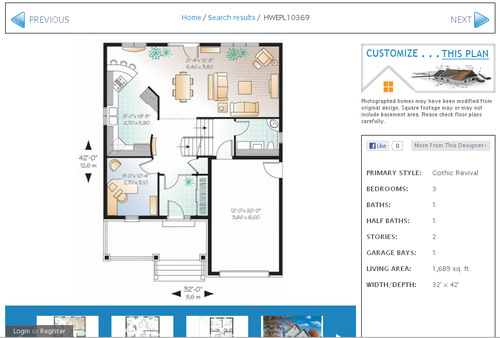
Eplans.com is a website that sells blueprints for houses.
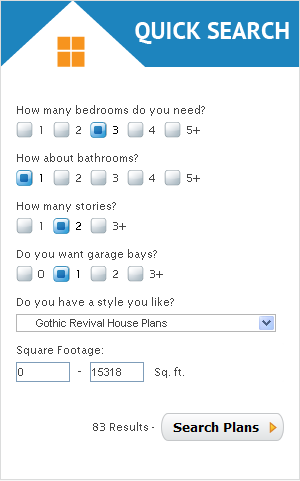
This might not seem that helpful but if you want a characters house you can make selections based on what sort of house you want them to live in.
Then browse through the results and find the house you want. Then you can view the blueprints and have a room layout for that house, which can help with visualising the space they live in.
It makes describing generic homes so much easier.
thank you
This is my favorite thing I’ve seen all day
Useful Thing from queue/drafts #1.
I haven’t played with it yet, so YMMV, but this looks like a Useful Thing for story construction and continuity. It may help you track where your characters are in a dwelling and work out how they get from Plot Point J to Plot Point K without falling down the staircase you described in Plot Point B (then forgot about).
Alternately it may not, in which case graph paper and a pencil always work.

In the Victorian era, hand-fans were used not only to cool oneself but also as a secret way to communicate the language of love. For example, by running one’s fingers through the fan’s ribs, one is trying to say, “I want to talk to you.” The enigmatic language of the fan was widely used by both men and women.
I. A fan placed near the heart.
“You have won my love.”II. A closed fan touching the right eye.
“When may I be allowed to see you?”III. A closed fan moved threateningly.
“Do not act so impudently!”IV. A half-opened fan pressed to the lips.
“You may kiss me.”V. Covering the left ear with an open fan.
“Do not betray my secret.”VI. Hiding the eyes behind an open fan.
“I love you.”VII. Shutting a fully open fan slowly.
“I promise to marry you.”VIII. Fanning oneself slowly.
“I am married.”IX. Letting one’s fan rest on the right cheek or the left.
“Yes” and “No”, interchangeably.X. Opening and closing the fan several times.
“You are cruel.”XI. Fan in front of the face.
“Follow me.”XII. Twirling the fan in the left hand.
“We are being watched.”XIII. Fan held over left ear.
“I wish to be rid of you.”XIV. Carrying an open fan in the left hand.
“Come and talk to me.”XV. Opening a fan wide.
“Wait for me.”XVI. Placing the fan behind the head with finger.
“Goodbye.”[Artwork: Secret, by Lee Yun-hi.]
aww nasa has a page for space technology terms you can use in science fiction
nerds
This is actually pretty frickin’ incredible. I love you, NASA.
- Spears, Sorcery, and Double Consciousness (Part 2) (Part 3) – a series about African-inspired fantasy and the Western vs Non-Western writer.
- Sexy Loki, Queer Tricksters, and the Problem with LGBT Villains – an opinion piece on how lgbt+ villains are written and used in fiction.
- Postcolonial Fantasy and African Against the Word “Tribe” – a discussion on the use of the word “tribe” in fiction, especially fantasy.
- The “Other” Histories of Fantasy – about (the lack of) non-European settings in fantasy and drawing from history.
- Fantasy’s “Othering” Fetish – about the portrayal of POC in fantasy, particularly how they are “othered”.
- Green-Eyed Asian – about giving POC traits that are more common in white people in an attempt to “beatify” or “exotify” them.
- Respective Portrayals of Asians in the Media and How to Balance Them – a primer on stereotypes and portrayals of Asians and Asian-Americans in American media.
- No Queens in Afrika: Women Rulers in Sword & Soul and Other African-Inspired Fantasy – about the use of the word “queen” in relation to non Western European (mostly African) female rulers.
- Tropes of Women of Color in Sci-FI – an eight-part series looking at five tropes that surround women of color in sci-fi.
- Why Sci-Fi Keeps Imagining the Subjugation of White People – an article about the popular topic of colonialism and anti-colonialism in sci-fi.
- On Black Women, Teen TV, and Fantasy Space – a short article about the desirability of black women in fiction and its relationship with women being validated “through heteronormative romantic success”.
- On the Erasure of People of Color from Dystopian Fiction – about the absence of POC in speculative fiction, particularly futuristic settings.
- Mary Anne Mohanraj Gets You Up to Speed Part I (Part II) – a two-part essay about race and racism in fiction and about writing a race other than your own.
- You’re Hurting My Head Again SF/F – a rant on erasing an entire race for the sake of an alternate history.
- Diversity and Disability – about the lack of representation for disabled people in YA fiction and the two tropes that often surround disability in fiction.
- No, Really, Stop Raping Your Women! – disputing arguments that favor rape and sexual assault against women in fantasy.
- Monstrous Females and Female Monsters – on the difference between the portrayal of male monsters and female monsters, and on what makes a female character a monster.
- How White Writers Should Address Racism – a short post on how characters address racial and ethnic prejudice in fiction.
- Dystropia: Why the Sassy Gay Friend Isn’t Progressive – an article on writing “sassy gay friends” and how it can turn bad quickly.
Do Not Link allows skeptics to ethically link to content we wish to criticize, without unintentionally promoting it.So you know how when you criticise an article on a horrible site like the Daily Mail and link so people can see the original page, search engines see that as “someone is interested in this page,” and activity by people criticising the page looks just like activity by people liking it? So the horrible site goes up the Google search results? And the horrible site goes “whooo, lots of hits and links, guess that article was popular” and decides to create more horrible articles like it?
When you’re linking to horrible sites, use DNL: from the user end it works like tinyurl or bit.ly, but it doesn’t give the website attention.
{ this is a skill i’ve been using a lot lately, thought i’d share 🙂 }
{ Distress Tolerance Skill: Coloring Mandalas
PRE-PREP
1} go to www.printmandala.com and print a couple of mandalas that you like. (you can also find some on google images.)
2} buy set of colored pencils or markers if you don’t have them. more colors = better
3} buy a clipboard if you wanna lie in bed and color.
4} set these aside and ready to go so they are easily accessible when you are distressedHOW TO USE DURING DISTRESS
1} choose a mandala from your pre-printed stash
2} set a timer (phone is good) for 30 minutes
3} color it with ur markers or pencils. i prefer pencils.
4} optional: play an audiobook or music while coloring. make sure it’s not sad music.
5} when timer goes off, stop coloring. ask yourself, what level is my distress right now? if still high, set timer for another 30 minutes and keep coloring. if tolerable, stop coloring and do thing you want to do.
6} repeat as needed until distress is tolerableWHY IT WORKS
coloring patterns is distracting enough to pull your attention away from negative thoughts/emotions, but mandalas are also repetitive so you can kind of “zone out” while coloring. it feels good being able to create something and you feel a sense of competency or confidence. there’s no competitive aspect to it so you can just do the activity without having to worry about doing it perfect or right or better than anyone else. it can remind you of a simpler time when all that was expected of you was coloring. 🙂 it is easy and almost everyone can do it.
TIPS
— stick to the timer. even though you want to keep coloring when it goes off, stop once you finish the segment you’re on and put the pencil down. tell yourself you can come back and finish it after you do the thing you’re putting off.
— you can do this activity without using a timer, especially if you don’t have anything planned for the rest of the day and aren’t using this to distract from a task :))
— practice coloring during times when you’re not distressed, so that when you need to use this skill it will be easier and more “automatic”. i can’t stress this enough. even though coloring is really simple, it’s much better for the activity to feel familiar so that you can easily use it during distress. so if you can practice it during normal times it’ll help u. think of it as homework if you have to — you are building up a memory muscle.
— if you feel guilty because you’re “wasting time” doing a “childish activity”, remind urself that ur doing this for your mental health, that this is an established skill recommended by top psychotherapists, and that calming down your distress so you can actually *do* the stuff you’re worried about (rather than procrastinating all day about the thing and not actually doing it) is the opposite of wasting time. remember that practicing this skill even when you’re not distressed is HOMEWORK, not optional time wasting thing. also, taking care of ur mental health is not a frivolous activity. it’s very important and crucial to a happy successful life.
I’d like to add that coloring inside the lines neatly and skillfully is something that impresses the fuck out of most artists. Yes, even professional working artists. I have seen artists genuinely lose their shit with admiration when someone could color inside all the lines (sometimes that artist is me). SO if you’re coloring and thinking ‘this is dumb i’m not an artist i bet an artist would laugh at me’ be assured most artists would actually be hooting enviously at you and then asking to borrow your crayons.
This is so cool.

 This Is a Backup Blog