sometimes people try to tell me that scientists are paragons of rationality and I have to break it to them that I have yet to work in a lab that didn’t have at least one weird secret shrine in it
new guy: why is all of the equipment in this room covered in toys?
me: dONn’t touch those
new guy:
me: they need the toys to function. if they don’t all have toys they get jealous.
new guy:
new guy:
me: when something breaks just take the wizard and wave it around for a while. they seem to like that.
1. Doctor finds anecdotal evidence that people are passing kidney stones after riding on Big Thunder Mountain Railroad at Disney World
2. Doctor makes 3-D model of kidney, complete with stones and urine (his own), takes it on Big Thunder Mountain Railroad 60 times
3. “The stones passed 63.89 percent of the time while the kidneys were in the back of the car. When they were in the front, the passage rate was only 16.67 percent. That’s based on only 60 rides on a single coaster, and Wartinger guards his excitement in the journal article: ‘Preliminary study findings support the anecdotal evidence that a ride on a moderate-intensity roller coaster could benefit some patients with small kidney stones.’”
4. “Some rides are going to be more advantageous for some patients than other rides. So I wouldn’t say that the only ride that helps you pass stones is Big Thunder Mountain. That’s grossly inaccurate.”
5. “His advice for now: If you know you have a stone that’s smaller than five millimeters, riding a series of roller coasters could help you pass that stone before it gets to an obstructive size and either causes debilitating colic or requires a $10,000 procedure to try and break it up. And even once a stone is broken up using shock waves, tiny fragments and “dust” remain that need to be passed. The coaster could help with that, too.”
SCIENCE: IT WORKS
Update:
“In all, we used 174 kidney stones of varying shapes, sizes and weights to see if each model worked on the same ride and on two other roller coasters,” Wartinger said. “Big Thunder Mountain was the only one that worked. We tried Space Mountain and Aerosmith’s Rock ‘n’ Roller Coaster and both failed.”Wartinger went on to explain that these other rides are too fast and too violent with a G-force that pins the stone into the kidney and doesn’t allow it to pass.“The ideal coaster is rough and quick with some twists and turns, but no upside down or inverted movements,” he said.
I just love this because it’s HILARIOUS and yet also a perfect archetypal example of The Scientific Method:
1. Hypothesis
2. Experiment
3. Results
4. Discussion
5. Conclusions
6. GOTO 1 (the scientific method is iterative, don’t forget that part)
was this like… done in cooperation with disney management or did some random scientist go through bag check with a 3d printed kidney and a bottle of piss and start looking for big thunder mountain fastpasses
Of course, the researchers had to get permission from Disney World before bringing the model kidney onto the rides. “It was a little bit of luck,” Wartinger recalls. “We went to guest services, and we didn’t want them to wonder what was going on—two adult men riding the same ride again and again, carrying a backpack. We told them what our intent was, and it turned out that the manager that day was a guy who recently had a kidney stone. He called the ride manager and said, do whatever you can to help these guys, they’re trying to help people with kidney stones.”
Almost all insects suffer from some form of parasitic mite, but certain potter’s wasps have pockets on their bodies that seem to serve no purpose other than to carry around and protect the very mites that suck their blood.
When the wasp lays her eggs, the mites pour out of the “acarinaria” ( “acarinarium” = a place for keeping mites!) and enter the nest where they feed on the blood of her developing babies, but not enough to stunt or kill them.
It’s all worth it because there are tinier, parasitoid wasps that lay their eggs inside of young potter’s wasps, which obviously DOES kill them, but as soon as a parasitoid wasp breaks into the potter’s nest, the parasitic mites switch to an aggressive territorial mode and successfully drive off or kill the majority of invaders.
Here’s another one, this time a vertebrate! The great spotted cuckoo (Clamator glandarius) is one of those cuckoo species that doesn’t evict all its host’s chicks from the nest. In fact, it doesn’t mind sharing, but ultimately the cuckoo chick is bigger and beggier than its “siblings” and so gets the lion’s share of the meals. The overall health of its host’s chicks (usually corvids) suffers as a result.
So how does it help its host? Turns out that baby great spotted cuckoos fire a foul liquid from their cloacas as a defense against predators. In areas where predation is high, nests parasitized by cuckoos actually have a higher survival rate for everyone involved than unparasitized nests, thus making it better to have a parasite than not!
It’s a fine balancing act to be sure, since in the absence of predators it goes back to being detrimental to the hosts. But that’s another example of parasites helping their hosts.
I actually didn’t know this and I’m so glad to know that there is a changeling baby in nature that may murder a real baby but goes on to protect its adopted family by shitting at people
domestication syndrome is one of the coolest findings from recent genetics
Yes!
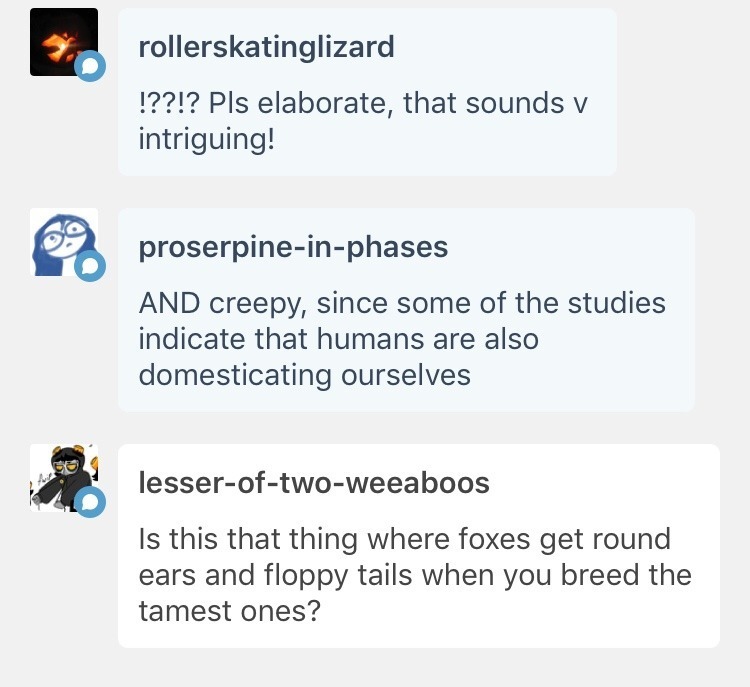
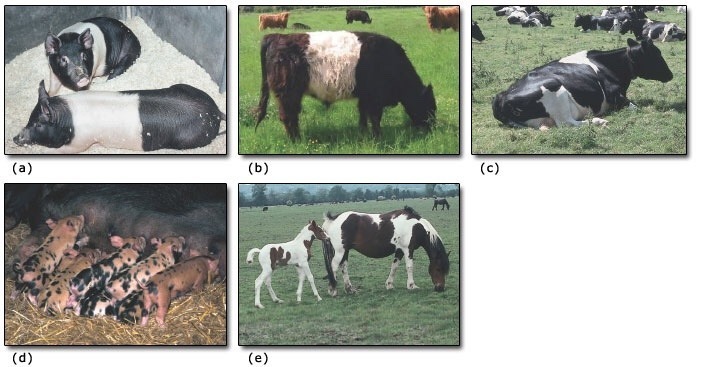
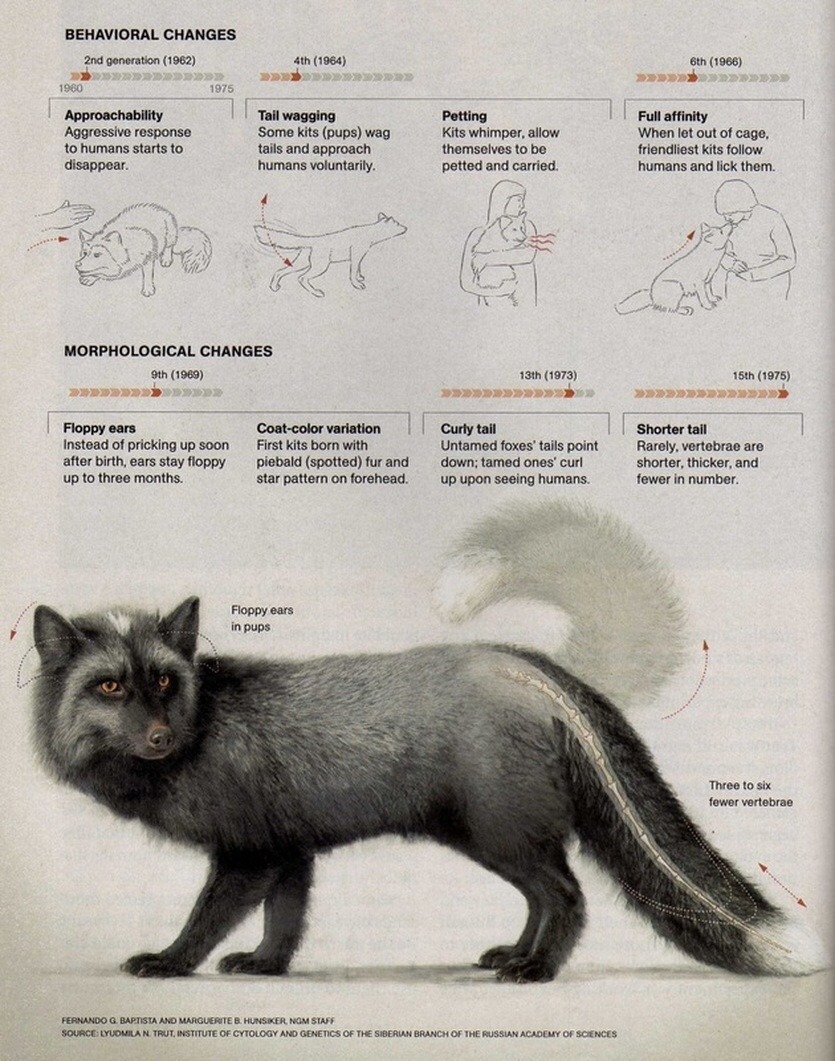
Basically scientists have found that if you start selecting for people-friendly animals, you see a bunch of hypothetically unrelated traits start showing up in all sorts of mammal species: floppy ears, piebald/patterned coats, etc.
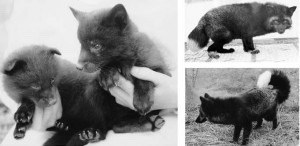
This is true for everything from cows to dogs to rats! One of the coolest long term studies on this has been the Russian fox experiments.
So essentially the science goes like this:
You have two copies of every genes, one from each parent.
We tend to simplify genetics, and say that for every single gene you have it is random,l coin flip which copy you pass on to you offspring. We also tend think of genes as a 1:1 ratio of genes—>traits.
But! This is not quite the case.
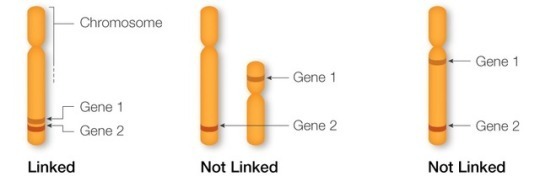
Genes have a specific physical location and order relative to each other on your chromosomes, and the chance of genes being inherited together goes up the closer together they are located. This means random, unrelated traits can wind up being more commonly inherited together in specific patterns just because those genes are located close together, and you don’t get that completely random reshuffling of two parent’s traits. Some of them tend to stay “stuck” together.
This is called linkage, and it’s why you often see red hair, pale skin, and freckles together, for example.
The second factor that plays into this is that a lot of times 1 gene affects several different traits (or several different genes affect 1 trait). This means that sometimes you really *can’t* untangle two traits because they have a similar cause. For example, say genes for increased aggression are responsible both for making a spider a better hunter (pro) and making a spider more likely to eat its offspring (con). Because the same gene is the cause of both things, natural selection can’t really untangle them.
Circling back to the redhead/freckles/pale skin example, these traits are affected by a number of different genes, but also one gene in particular: MCR1, a gene that changes how your body responds to hormones promoting melanin production. Again, one gene related to pigment production can affect a BUNCH of different traits. (And also skin cancer risk. Fun!)
Domestication Syndrome in mammals turns out to be due to both linkage and genes affect by multiple traits!
See, when we domestic animals we want them to be friendlier/less aggressive, which normally translates to less FEARFUL.
And it turns out that the same genes involved in adrenal responses and other stress reactions are also involved in melanin, cartilage, and bone production. So when we domesticate animals we get these recurring changes in pigmentation (white patches, piebald costs), floppy ears (cartilage), shorter muzzles and other changes in physical stature (bone growth), etc.
We also wind up selecting for a lot of neotenic genes in general— that is, retention of childhood traits into adulthood. That’s because baby animals tend to have lots of friendly/trusting/biddable/curious traits we are looking for.
And honestly, who can say no to a face like this?
ps, since it was mentioned:
the same genes involved in domestication probably help animals form social groups in general. if you need to get along with and trust strangers you need a decrease in the panic/aggression genes.
cats, for example, probably domesticated themselves when they started living close to each other and to humans to feed off of pests in grain silos.
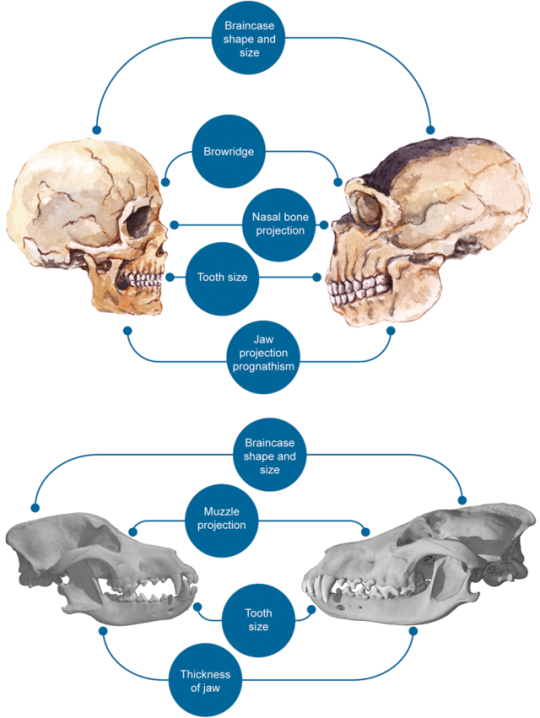
and yeah, some some recent theories suggest humans may have ‘domesticated’ themselves:
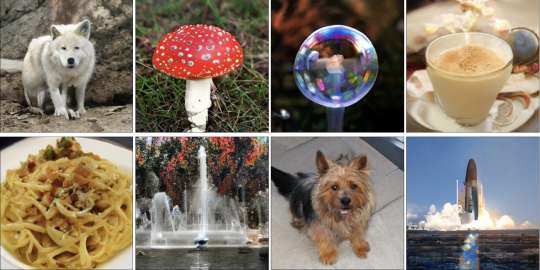
These are some of the most amazing generated images I’ve ever seen. Introducing BigGAN, a neural network that generates high-resolution, sometimes photorealistic, imitations of photos it’s seen. None of the images below are real – they’re all generated by BigGAN.
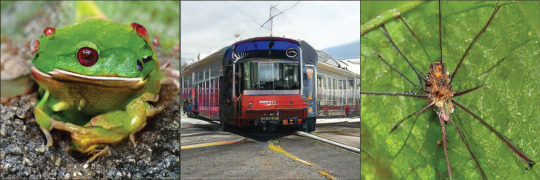
The BigGAN paper is still in review so we don’t know who the authors are, but as part of the review process a preprint and some data were posted online. It’s been causing a buzz in the machine learning community. For generated images, their 512×512 pixel resolution is high, and they scored impressively well on a standard benchmark known as Inception. They were able to scale up to huge processing power (512 TPUv3′s), and they’ve also introduced some strategies that help them achieve both photorealism and variety. (They also told us what *didn’t* work, which was nice of them.) Some of the images are so good that the researchers had to check the original ImageNet dataset to make sure it hadn’t simply copied one of its training images – it hadn’t.
Now, the images above were selected for the paper because they’re especially impressive. BigGAN does well on common objects like dogs and simple landscapes where the pose is pretty consistent, and less well on rarer, more-varied things like crowds. But the researchers also posted a huge set of example BigGAN images and some of the less photorealistic ones are the most interesting.
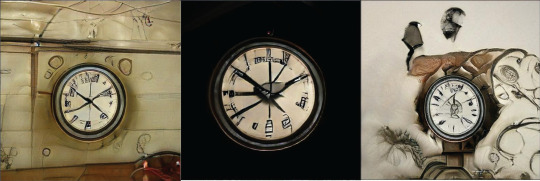
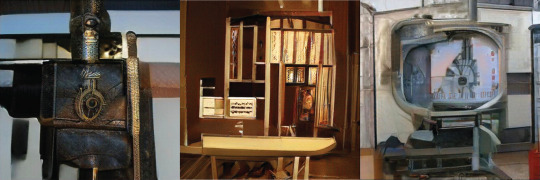
I’m pretty sure this is how clocks look in my dreams. BigGAN’s writing generally looks like this, maybe an attempt to reconcile the variety of alphabets and characters in its dataset. And Generative Adversarial Networks (and BigGAN is no exception) have trouble counting things. So clocks end up with too many hands, spiders and frogs end up with too many eyes and legs, and the occasional train has two ends.
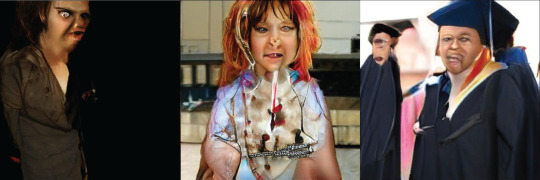
And its humans… the problem is that we’re really attuned to look for things that are slightly “off” in the faces and bodies of other humans. Even though BigGAN did a comparatively “good job” with these, we are so deep in the uncanny valley that the effect is utterly distressing.
So let’s quickly scroll past BigGAN’s humans and look at some of its other generated images, many of which I find strangely, gloriously beautiful.
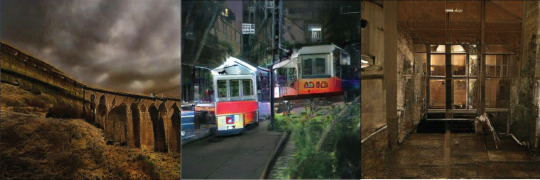
Its landscapes and cityscapes, for example, often follow rules of composition and lighting that it learned from the dataset, and the result is both familiar and deeply weird.
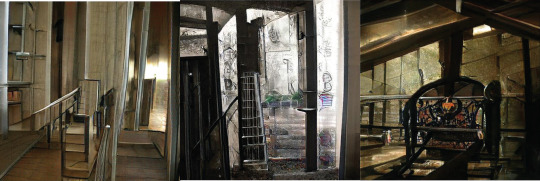
Its attempts to reproduce human devices (washing machines? furnaces?) often result in an aesthetic I find very compelling. I would totally watch a movie that looked like this.
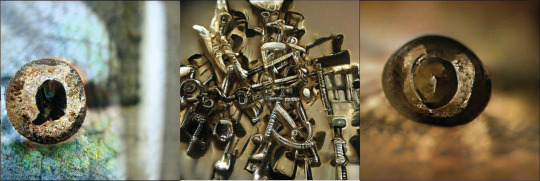
It even manages to imitate macro-like soft focus. I don’t know what these tiny objects are, and they’re possibly haunted, but I want them.
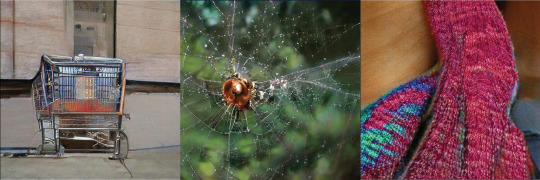
Even the most ordinary of objects become interesting and otherworldly. These are a shopping cart, a spiderweb, and socks.
Some of these pictures are definitely beautiful, or haunting, or weirdly appealing. Is this art? BigGAN isn’t creating these with any sort of intent – it’s just imitating the data it sees. And although some artists curate their own datasets so that they can produce GANs with carefully designed artistic results, BigGAN’s training dataset was simply ImageNet, a huge all-purpose utilitarian dataset used to train all kinds of image-handling algorithms.
But the human endeavor of going through BigGAN’s output and looking for compelling images, or collecting them to tell a story or send a message – like I’ve done here – that’s definitely an artistic act. You could illustrate a story this way, or make a hauntingly beautiful movie set. It all depends on the dataset you collect, and the outputs you choose. And that, I think, is where algorithms like BigGAN are going to change human art – not by replacing human artists, but by becoming a powerful new collaborative tool.
The BigGAN authors have posted over 1GB of these images, and it’s so fun to go through them. I’ve collected a few more of my favorites – you can read them (and optionally get bonus material every time I post) by entering your email here.
So there’s this experiment where researchers take a bunch of preschoolers and give them a marshmallow and they say, “ok, you can eat this now, or you can wait thirty minutes and then we’ll give you two marshmallows.”
And they leave them alone with hidden cameras and watch the struggle of willpower and it’s supposed to say something about delayed gratification.
And this thing gets used to explain why some people are better with money than others, or make various other better life choices. The Aesop here is if you can delay your satisfaction, you’ll get ahead.
But here’s a proposed version of that experiment that’s more realistic.
Give the kid the marshmallow and explain it all as above. Then come back 30 minutes later and say, “Sorry, actually we ran out of marshmallows, so even though you didn’t eat yours, you’re not getting a second one. Other kids got two, but you don’t. Also, every kid with fewer than two marshmallows has to give back their original marshmallow. Sorry we didn’t tell you that earlier now hand it over.”
Then call them back for a repeat experiment where you give them the same offer. See how many kids scarf that marshmallow down in two seconds flat because like hell they’ll trust you again.
If it’s the experiment I’m thinking of they did run the experiment again, and this time did take into account something they didn’t before: the socio-economic level of the children involved and if there had been broken promises made before to them. Children from lower socio-economic circumstances who had been let down in the past were far more likely to eat the marshmallow the first time around. The experimenters then showed the kids they had the two marshmallows to give them and let them out.
Then comes the fun part: they ran the experiment again.
This time, those kids who ate the marshmallow before waited. Without any further prompting than keeping their word, the scientists destroyed the notion that children in poverty are more prone to poor impulse control or are more likely to scarf down sugar than rich kids.
Oh now that is interesting! I’d never heard that follow-up before.
When I first learned about this case study in college, something about it felt incomplete, but I could never really put my finger on it. It seemed overly simplistic, but I couldn’t see the missing piece because in was in one of my cognitive blind spots.
Knowing about this follow up is incredibly valuable and insightful!
And this is why it’s vital for human beings to check our assumptions and always be on the lookout for cognitive blind spots. Because even one missing variable can mean the difference between transformative insight and generations of deeply embedded misconceptions.
This is also why it’s important for the scientific community to actively seek out scientists with diverse backgrounds and perspectives. It’s not about arbitrary “diversity quotas,” it’s about pursuing a diversity of insight.
:^)
Source?
I have a source, and not only does it key on the idea of the kids being more able to wait if they know the adults will be likely to keep their promises, but it also compares the waiting times of kids from Germany to kids from Cameroon, and found that the Cameroonian kids (unlike the German kids) almost all had absolutely no problems with the test, because they were raised in a completely differently way–a way that was based on their parents anticipating the children’s needs, so the kids already knew they adults would keep their promises and so the kids had no need to be upset (the report states that “being upset” is strongly discouraged in their culture) https://www.npr.org/sections/goatsandsoda/2017/07/03/534743719/want-to-teach-your-kids-self-control-ask-a-cameroonian-farmer SO YES no matter how you look at it, it’s really a test of the children’s parents, not the children.
me in third grade: i cant wait to get to college so i can do labs and things like a Real Scientist!!!! it’ll be so fuckin cool and exciting and not boring at all!!!
“Surfaces covered with pebbles and small rocks can often be found in nature or in human shaped environments. Generating an accurate three-dimensional model of those kind of surfaces from a reference image can be challenging, especially if one wants to be able to animate each pebble individually. To undertake this kind of job manually is time consuming and impossible to achieve in dynamic terrains animations. The method described in this paper allows unsupervised automatic generation of three-dimensional textured rocks from a two-dimensional image aiming to closely match the original image as much as possible.”






 This Is a Backup Blog