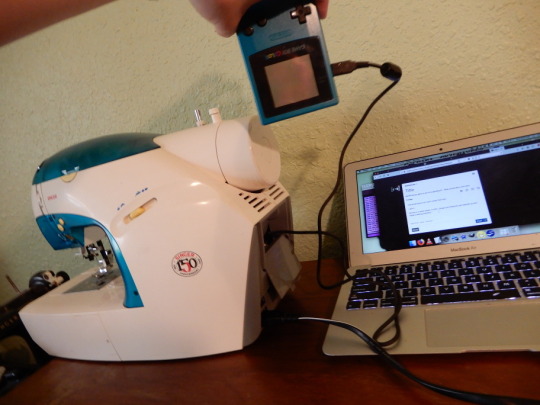
We live in a world where, in 2001, Singer and Nintendo just teamed up and made a sewing machine one day, and called it the Singer Izek. (Well, that’s not totally true. Details to follow).
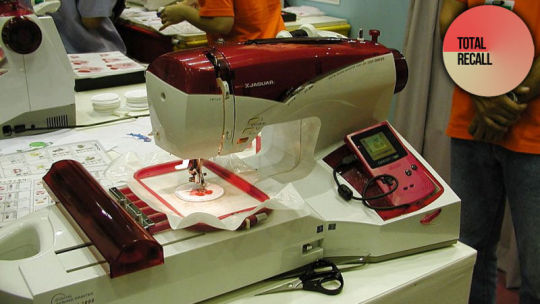
Gameboy connection cable’s just hardwired into the side. It’s got a little compartment to protect it, and when I opened this compartment at the thrift store and saw a link cable in it, I knew I was getting this machine, because that’s just TOO WEIRD. (This image is also proof that I take pictures as I write the posts)
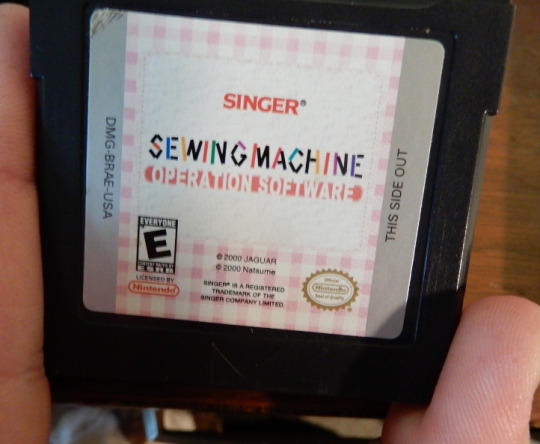
The cartridge is an officially licensed, real GBC cart. Got the Nintendo seal and everything.
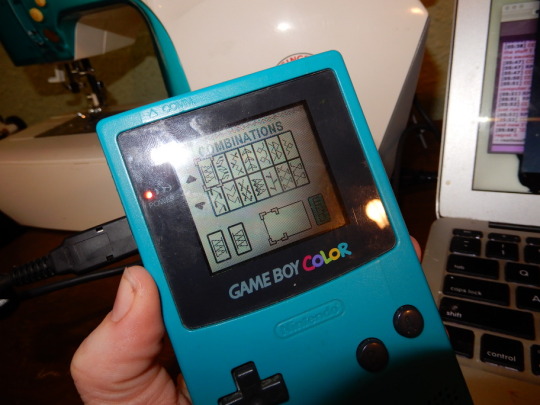
For those of you who have blocked out all your childhood memories of playing Pokemon Yellow in the back of the car at night and waiting for streetlights so you can see what you’re fighting, or for y’all whose first handheld was the GBA SP or later, I need to remind you that the gameboy color doesn’t have a backlit screen, so all the pictures I take are going to be with the flash on, and that’s going to be kind of tough to see. It’s a lot easier to actually read the screen in person, but it does make me have minor Oracle of Seasons flashbacks every time I forget and move away from my desk light.
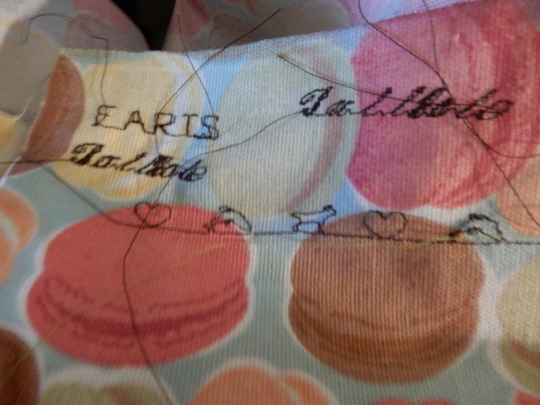
The software’s pretty cool. It’s got several different patterns, including dogs and stars. Unlike my other computerized machines, it lets you flip the patterns vertically. You can also program in words, and it’ll embroider the whole word in one go. The jump threads are a bit of a pain to clip, and some of the letters are indecipherable. The cart’s got full sound, though it’s GBC sound, so it’s nothing special.
This machine thinks it has a one-step buttonhole in five shapes, though the actual execution is questionable. If you’re only making one buttonhole, and you don’t really need to worry about if it’s in the right place, well, it’s a great buttonhole. Otherwise, you might be better off just zigzagging it.
The machine’s got a weird housing, which it shares with the Japanese Jaguar machine line, which also ran off Game Boy.
The whole machine’s summed up with the phrase, “functional, but weird.”
So, the real answer to the great question we never thought we needed to ask: Why did Nintendo and Singer, of all companies, team up and make a Game Boy Color controlled sewing machine?
So, this machine is actually a really cool little piece of sewing machine history, because it’s actually the first commercially made computerized machine available for the domestic market. All previous computerized machines were either specialty made one at a time, or industrial.
Singer wanted to bring the computerized machine to the home market, but developing their own computer that could do everything they wanted a computerized machine to do and could fit inside the machine was going to be too expensive for it to be accessible by the average domestic sewing machine buyer.
But Nintendo already had this cool little handheld computer thing, and Nintendo was pretty cool with letting Singer design software for their sewing machine that could run on the Game Boy.
Due to inflation and the fact that it was more than 15 years ago, it’s kind of easy to forget that the Game Boy Color was incredibly cheap compared to today’s consoles. It was $70, which I think is like $100 price-adjusted to today. If Singer put in an internal computer in the Izek, they’d have to source and assemble a lot of hardware and figure out how to fit it into their weird bulbous machine. However, building the software for the Game Boy didn’t require assembling any hardware, and sticking a Game Boy in the box with the machine only added $100 to the price, making it the most cost-effective way to get a computerized machine into the domestic market. And Singer got to slap their name on it and comment FIRST! in front of everyone else in the sewing machine game.
Unlike the Jaguar, which was the Japanese sewing machine that used the Game Boy and the same housing, the Singer Izek wasn’t marketed at gamers at all. There’s no way to embroider Yoshi on things with the Izek, unfortunately. The Izek was aimed at Singer’s usual market, and they just used the Game Boy because it was convenient and cheap.
This is my friend TJ, wearing a costume she made for Halloween, 1977. She was 16 at the time.
Now, keep in mind: there was no internet to search for images. She could not have rented and paused the movie, because it wasn’t released on video until 1982. No, TJ just went to the movie a bunch of times, took notes with a flashlight, drew a bunch of sketches, and put this together.
In 19-fucking-77. So let’s bury this bullshit about how women didn’t grow up on Star Wars.
I’m gonna be famous for Star Wars for nothing else but this bread! It was a little gag which was incredibly successful, everybody thought it was CGI. We moulded up an inflatable bread so that it was deflated underneath the liquid and then we slowly inflated it and sucked out the liquid with vacuum pumps at the same time to produce this bread coming up and forming. You wouldn’t believe how long it took to actually perfect that one, that little tiny gag in the film. It started off with the mechanics of getting the bread to rise and the liquid to disappear, but then there was the ongoing problem of what color should the bread be? What consistency should it be? Should it have cracks in it? Should it not have cracks in it? It took about three months.
For an ongoing project entitled Rainworks, Seattle-based artist Peregrine Church creates awesome works of street art that are only visible when it rains. It’s a particularly wonderful concept for a city renowned for its rainy weather Church uses a superhydrophobic coating to stencil images onto ordinary pavement. On a dry day the pieces are completely invisible, but when the surface gets wet, darkening the untreated concrete, the treated areas repel the moisture, which causes the stenciled images and/or text to appear. Depending on the amount of foot traffic the treated surface receives, Rainworks will last anywhere from 4 months to a year.
Watch this video to learn more about how Peregrine Church creates his dissapearing-reappearing artwork.
Want to try making Rainworks of your own? There are a variety of superhydrophobic coatings currently available, including a handy kit by Rust-Oleum.
Traveling with your spice rack is not ideal. This is why Japanese company, Muji, has made a book of spices to make flavoring your food while away from home a little bit easier.
This book from Muji is full of pages that are made of spiced paper, which dissolve from the heat and moisture of cooking. Now that kick of white pepper or red chili is just a tear away. And, since it is compact and perfectly portable, the Muji spice book is ideal for when you’re traveling!




 This Is a Backup Blog